

Two Exercises in Contemplative Walking
Part of our Teach Us to Pray series
This is the text of a presentation on contemplative walking offered at Precious Blood Renewal Center, Liberty, Missouri, on July 9, 2026. The presenter was Dennis Coday, director of engagement at the Renewal Center. Learn more about the Teach Us to Pray series here and here.
First a little bit about me. I am not an expert in contemplative practices. If you want real expertise, look to other people and other resources. The website of Contemplative Outreach Kansas City is a good place to find local experts. And of course, the Renewal Center offers workshops and presentations with some real experts.
I am a novice when it comes to the topic of contemplative practices, but what I think I can offer you tonight are a few ideas or techniques that I have stumbled across in my meandering through this topic. Over the course of my life, I have been exposed to various prayer practices. In high school and college, I had teachers and adult leaders who offered classes and workshops on prayer and meditation and such. When I was living in Bangkok, I was invited to join a group attached to the World Community for Christian Meditation, a movement run by two English priests, Fr. John Main and Fr. Lawrence Freeman. That was my first encounter with what I call “hard core Christian meditation.” I attended those meetings off and on, but more off than on. I had similar invitations and experiences when we relocated to Liberty in 2003.
I guess you could say that I was always aware of these practices and dabbled in them over the years, but it wasn’t until 2017 that I felt like I really needed a contemplative practice in my life. Let me correct that. I knew I needed something, and eventually I discovered that something was a contemplative practice.
In the fall of 2017, I lost a job that I really liked and thought I was good at, and my youngest son — the last of my three sons living at home — moved away to college and my wife and I began our first try at empty nesting. In fairly quick succession, I lost two things that had anchored me in my life. I felt disconnected and a little bit discombobulated. I knew I needed something stabilizing, but I wasn’t sure what.
Gradually I found the group Contemplative Outreach of Kansas City, the local chapter of the international group Contemplative Outreach. The founder and spiritual guide of Contemplative Outreach was a Trappist monk, Fr. Thomas Keating. His book Open Mind, Open Heart is one of the classic resources on centering prayer and Christian Meditation. It has been in continuous printing since it first appeared in 1986.
Several organizations or movements emerged in the Catholic church community in the 1960s, ‘70s and ‘80s with the aim of promoting Christian meditation. I’ve mentioned already the World Community for Christian Meditation and Contemplative Outreach. Another group that has great online resources is Grateful Living, whose spiritual guide is a Benedictine Brother David Steidl-Rast, who will mark 100th birthday on July 12. You can find them online at grateful.org.
All are focused on spreading the practice of Christian meditation, and I am pretty sure the founders of these three movements spent a good deal of time together, learning from each other. Fr. Keating, who lived most of his religious life at Snowmass Monastery in Colorado, convened a number of high-level symposiums on Christian Meditation at his monastery in the foothills of the Rocky Mountains. They are pretty much the same, but offer slightly different takes on centering prayer. For example, Fr. Lawrence suggests using a mantra in meditation. Fr. Keating eschews the use of mantra.
Anyway, in late 2017, I eventually found myself joining a centering prayer group in Kansas City and trying to make centering prayer a daily practice. (What is centering prayer? Here’s an introduction to the practice.) I have joined online workshops and book studies to learn more about centering prayer. Some those workshops/classes were here at the Renewal Center. I can’t say it totally turned my life around, but I can say to it has helped in my healing process.
A parallel development has been my feeling the need to live a healthier life, which led me to daily walking for physical fitness. For the last several years, I have tried to walk every day, at least 20 minutes a day, but the goal is 50 minutes a day. As you can imagine, that has been very beneficial for my physical health.
Something that I didn’t expect was how, after a few months of my walking routine, I began to feel so much better about myself. I had more mental energy, more positive energy. I had a better outlook on life. That was a revelation to me.
That was a happening as I was continuing to study Christian Meditation; I found some teachers writing about incorporating movement into prayer practices. I was discovering thorough experience and study the mind-body-soul connection. As I read and thought more about this, it made more and more sense to me. Why? Stay with me here, because I’m going to walk into the weeds for a little bit.
Over the last two years, two works have especially influenced my thinking on this topic. One is a book we read here for Lent a couple years ago, Teilhard de Chardin on the Eucharist: Envisioning the Body of Christ by Louis M. Savary. The second work is Pope Francis’ encyclical on the Sacred Heart, titled “Dilexit Nos” (Latin for “He loved us”). The two works don’t really have too much in common except in the most general of terms.
Both of these works helped me focus on the incarnational aspect of God’s love for us. Both of these works asserted that God’s love is not an abstraction.
In his encyclical, Pope Francis first writes about the power of the heart as a symbol, a symbol of life. For example, think about the rush of emotions that envelops you when you feel the beating heart of another person. Pope Francis calls the heart of Jesus “the symbol of the deepest and most personal source of his love for us,” because it is not an abstraction.
“Christ showed the depth of his love for us not by lengthy explanations but by concrete actions. By examining his interactions with others, we can come to realize how he treats each one of us. … This becomes clear when we see Jesus at work. He seeks people out, approaches them, ever open to an encounter with them. We see it when he stops to converse with the Samaritan woman at the well … [when] he meets Nicodemus, who feared to be seen in his presence … when he allows his feet to be washed by a prostitute … [when] he asks the blind man on the roadside, “What do you want me to do for you?” Christ shows that God is closeness, compassion and tender love.”
Savary, in explaining Teilhard de Chardin’s thought, writes that God’s love is material. God’s love was made incarnate first in creation itself and most fully in Jesus Christ.
And as God’s creatures we are part of the incarnation. “God chose to put the divine gift of an immortal soul into each person’s living matter,” Savary wrote. “Think of it. Matter is what enables us to be human. Without matter, we cannot communicate. Without matter we cannot show or receive love. … without the matter of our bodies, we cannot laugh or cry, eat or drink, dance or sing … without matter we cannot pray or worship together.”
This notion of the incarnation is central to Christian understanding of what we are as humans. We are Body and Soul. Surely that notion has implications for our prayer lives, right?
The conclusion I came to (and the point of today’s exercises) is: Movement is good for your body and your soul. More than that, movement is necessary for your body and soul. By not incorporating movement into our prayer lives, we shut off a channel to meeting God.
So, movement is good for your body and your soul. When you move, you stretch your muscles, you breathe in air the nurtures your body, you sweat out toxins and your brain release chemicals that make you happy. The body is meant to be used. It feels good to stretch your muscles because that is what muscles are for.
So, the task I set for myself was how to incorporate movement into a prayer practice. There are many ways to do this. You might try yoga or tai chi. I think dance would be a good way to incorporate movement into prayer, but I can’t dance. The most accessible movement available to the largest group of people is walking.
We all walk — at least a little bit — every day. Most of our walking is for a specific purpose; we walk with a destination in mind. If we walk for fitness, that too has a destination, even if we’re walking laps we are walking to get somewhere.
What we don’t do is walk contemplatively. Contemplative walking doesn’t have a destination. Contemplative walking is walking with intention and attention. We will walk deliberately. Writing about contemplative walking in Earth, Our Original Monastery, Chrstine Valters Painter writes, “This is the whole of the practice: to walk and be present. To breathe deeply and keep returning to the now.”
Painter also challenges us to get outside every day. No matter how hot or cold or how rainy or snowy it is, get outside. Of course she lives in Ireland, so doesn’t have to contend with midwestern summers and winter! Still, it is good advice.
I think Savary would add, channeling Teilhard de Chardin, that a walk in nature is an encounter with God’s creation, a tangible manifestation of God’s love for us that envelops us.
Painter says, walking in nature every day, even if that nature is a sidewalk on a city street, you will find “the world is charged with the grandeur of God.” A quote from the English Jesuit poet Gerard Manley Hopkins. So, walk outside with intention and attention. Give yourself over to the experience. Walk to immerse yourself in an encounter with whatever is calling you in the moment.
As you walk, look, listen. Pause. Breathe. Painter says that in paying attention to that now moment, “something will catch you.” Walking with intention and attention, opens a space in your heart to receive the gift of life around you.
Painter coaches us: “Practice presence so that you might cultivate your ability to hear the voices speaking to you.”
OK. Now let’s move to a couple of walking exercise.
A Slow Quiet Walk
This exercise is a slow walk that can help you slow down when life seems a bit too fast. It is also a walk you can do indoors — you only need space to take 10 steps, although you can lengthen it over time as you become used its rhythm.
Watch the video above, or download this handout of instructions for the walk.
Walking in a New Way
This excercise is a 15-minute walk and should be taken outdoors. You could incorporate it with a walk you ordinarily take, like a walk to work or to school or to the store. The difference is in your intention. Normally you walk for a purpose, with a destination in mind. Today, for these 15 minutes, you will walk without a destination. The intention today is pay attention. Pay attention to your body. Pay attention to your surroundings, the sights and sounds and smells around you. Pay attention to the sensations that envelop you.
Watch the video above to follow an example of this exercise, or download this handout of instructions for the walk.
Both of exercises are adapted from exercises in the book Just Breathe: Meditation, Mindfulness, Movement and More by Mallika Chopra. It is a small book with lovely illustrations that aims at introducing mindfulness practices to young people.
Another good resource is Earth: Our Original Monastery by Christine Valters Painter. Each chapter of the book ends with a number of mindfulness exercises, including instructions for contemplative walking.
We’d Like to Hear from You!
We’d like to know what you think about this article. Send us a comment using the form below. Do you have a suggestion? Is there something you want to learn more about? Send us a note.
Related

Aging ain’t for wimps!
By Fr. Garry Richmeier, C.PP.S.
One of my mom’s favorite sayings was “Aging is not for wimps.” Aging is a piece of the human puzzle that many don’t like to talk or think about, because they fear the losses that come with it. We can’t stop the aging, but we can lessen the fear.
Take a Fall Prayer Walk with Fr. Ron
By Fr. Ron Will, CPPS
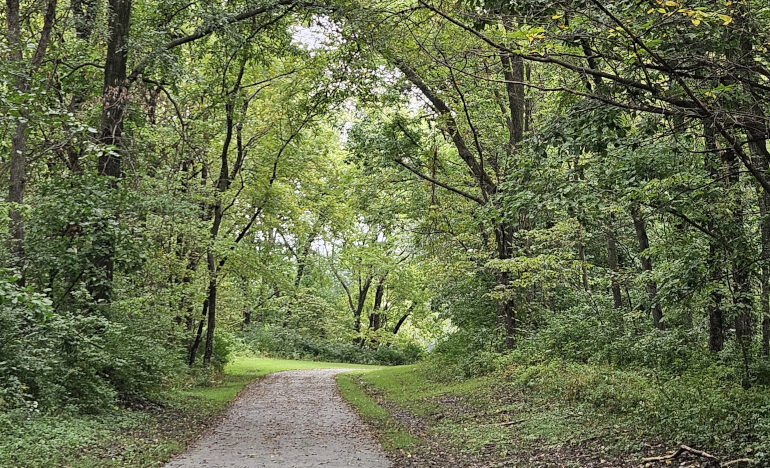
On the official first day of fall, I decided to make my daily walk a “prayer walk” and not just a walk for exercise. Join me on my walk and find inspiration for your own prayer walk, noticing God, by really paying attention to sights and sounds.