

Practice, Practice, Practice

An Assembling God’s Puzzle video
By Fr. Garry Richmeier, C.PP.S.
There is an old joke about a person in New York asking for directions. He asks someone on the street, “How do you get to Carnegie Hall?” The other person replies “Practice, practice, practice.”
We all know the value of practice, but we usually don’t like it much. Think of a child taking piano lessons, and how the parents often have to force the child to practice. I remember basketball practice in high school, where among other exercises, we had to make 10 free-throws in a row before we were allowed go do something else.
Practice is often boring, monotonous, and repetitive. It doesn’t have the excitement and “glamor” of a live performance, or an actual basketball game. It doesn’t seem to have a point, since nothing seems to be accomplished, and the goal is not immediately obvious. So we find it easy to skip practice, put it off till later, or find an excuse to do something else. But there is no substitute for practice if one is serious about changing something in their life.
Whatever we practice gets imprinted on our bodies, minds, and consciousness. With the body, we call it muscle memory. The muscles get accustomed to doing a certain activity the same way if it is repeated often enough. Therefore, my golf swing or my free-throw shot becomes more consistent.
The same thing happens in our brain, with our thoughts and perceptions. Each brain neuron sends a signal to certain other neurons when we have a particular thought. The neurons get accustomed to being connected to each other in that specific way, which makes it more likely we will think that same thought in the same way the next time.
This is handy when it comes to remembering information or using acquired mental skills. However, it is not helpful when the particular thought or perception is painful, scary, or intrusive. Changing the way we think about something involves getting the brain neurons to send signals to different neurons, to start connecting to each other in different patterns. This is where practice comes in.
To change our thinking, or to change how we look at things (including how we look at ourselves), we have to consciously practice different thoughts. We all can change our thinking fairly easily. For example, if I tell you to think of a purple banana, you can immediately do it, even though you probably have not had that thought before, and your usual thought is about a yellow banana.
So if I want to change some unhelpful way of thinking, I need to identify as specifically as possible the usual thought I’m wanting to change. For example, “Everyone is untrustworthy,” or “I’m a complete failure.” Either of those thoughts is likely to cause a person problems.
The next step is to identify a different thought to practice. For example, “I’ve met someone who I can trust,” or “I’m made in the image and likeness of God.” It is also always good to look for evidence that backs up the new thought, like experiences I’ve had which contradict the original thought.
The next step is to bring the new thought into our mind as often as we can, even if initially it feels weird, inauthentic, and not true. As we practice the new thought, and continue looking for evidence around us that supports the new thought, we start rearranging the connections among our our brain neurons.
Like changing a habit, we slowly get used to doing it differently. After a while, the new thought is no longer new, but is the usual way we think about things.
Practice is not the magic cure-all of problems. Before a person is even open to practicing something different, they have to believe there is a better way out there to make a free-throw, to hit a golf ball, to view others or themselves, or whatever.
Usually, the discomfort of doing and thinking of things in ways that don’t work will convince people to try something different. But not always.
We humans have an amazing ability to put up with much chaos, pain, fear, anxiety, and so on, before we start to look for a way out of it. Our habitual use of violence to try to solve problems is a perfect example. But once we open ourselves to the possibility that there is a better option out there, we are more apt to do the hard work of practicing it till it becomes our new way of life.
All of the videos in this series can be found here: Assembly God’s Puzzle.
Never miss an article published on the Renewal Center website: Sign up to receive our newsletters.
[Fr. Garry Richmeier, a Precious Blood priest and spiritual director, holds a Master’s of Divinity Degree from St John’s University in Collegeville, Minnesota, and a Master’s of Counseling Psychology degree from the University of Missouri-Kansas City. He is a licensed professional counselor and a licensed marriage and family therapist.]
Photo ID 106156001 | Basketball Practice © Alkan2011 | Dreamstime.com — Practice, Practice, Practice — An Assembling God’s Puzzle video
We’d Like to Hear from You!
We’d like to know what you think about this article. Send us a comment using the form below. Do you have a suggestion? Is there something you want to learn more about? Send us a note.
Related

What’s Wrong With Me?
By Fr. Garry Richmeier, C.PP.S.
Have you ever been nagged with the sometimes subtle, sometimes loud thought: “There’s something wrong with me”? I think we all have. If we want to be more at peace with ourselves, we need to deal with that thought.
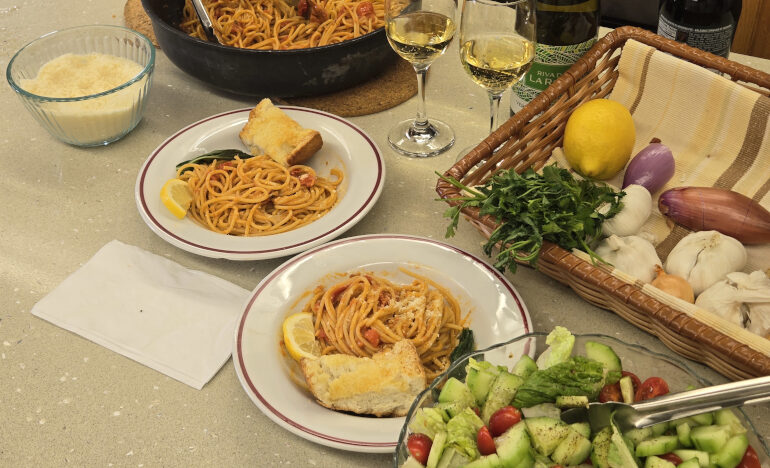
Pasta Dinner for Lent
Cooking & Spirituality by Lucia Ferrara
Today I am sharing another recipe that I grew up with — especially during Lent. I am not sure it even has a name; we just called it pasta with tomatoes and anchovies.