
Ties That Bind
An Assembling God’s Puzzle video
By Fr. Garry Richmeier, C.PP.S.
One of the most puzzling pieces of life for us human beings is how to balance individuality with relationality. We seem to be all over the place in this regard. On the one hand, we prize our independence. We want to make our own choices, we want free speech, we don’t like others deciding where our tax dollars go, we don’t like certain laws restraining our actions, etc. Especially in this country, we pride ourselves on being independent, self-made, with a “pull yourself up by your bootstraps” mentality.
On the other hand, we can sometimes easily give in to the “group think” mentality. We can attach ourselves to some group, some religion, some philosophy, or some political party, and blindly follow the herd like sheep, sacrificing our individuality.
As with most things in life, finding some middle ground between these two extremes is necessary for a satisfying, productive life. There are ways to work toward this balance.
One thing that is required in this regard is a true understanding that everything is connected. For some reason, many of us do not grasp the tremendous ramifications of this truth. But examples of this are everywhere.
There are many examples in nature. At one point in a certain area of Colorado, wolves were removed because they were killing livestock. This removed the only predators that hunted the elk. The elk over-multiplied, and needing more food, ate all the aspen tree seedlings. With fewer aspen trees, the beaver had no building materials, so they left. The people who removed the wolves never thought of how everything is connected, and didn’t consider the negative effects this would have on the ecosystem.
We humans tend to address problems like we would address fixing a machine that isn’t working. We figure if we can find the one part that is broken, we can replace it and the machine will work again. This is often our approach to solving the crime problem, for example. We think if we just get rid of the criminals, society will run better. We seem to overlook the fact that many other issues influence the crime problem, like poverty, unsafe neighborhoods, inadequate childhood education, etc. So the problem remains.
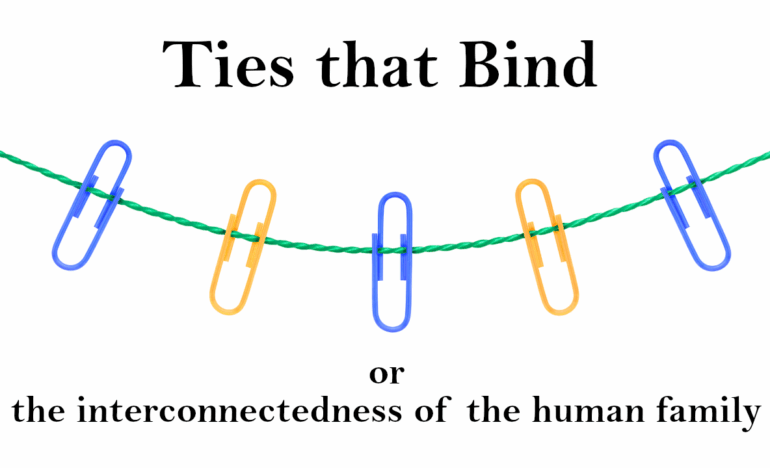
There is an image that I’ve found helpful in family counseling, to help me remember that everything and everyone is connected. I imagine five paper clips with rubber bands connecting each paper clip to every other paper clip. When one paper clip moves, it puts tension on all the rubber bands, resulting in a stronger pull on the other paper clips. No one paper clip can move without affecting all the others, and no one paper clip can move without experiencing a pull from all the others.
In family counseling, people will identify one person as the “problem paper clip” (e.g. the acting-out teenager, or the stressed-out mother), and want that person “fixed.” But there are all kinds of other issues involved in that web of relationships that need to be addressed also if the family is to reach some kind of balance. A good therapist needs to keep this in mind in order to provide help to the family.
Life in general works better when the connectedness of all things is kept in mind. One thing that is helpful in this regard is to practice broadening one’s view of any situation. In addition to focusing on how something affects me, I can also look around to see how others are affected. Who are the “stake holders” in the situation under scrutiny?
Listening for the tell-tale signs that a certain action is affecting certain people or groups of people is necessary. This requires the challenging work of putting ourselves in other people’s shoes to get a better view from that angle.
It is also important to resist the temptation of focusing only on immediate results. The long-term ramifications of anything we do has to be part of the equation for our actions to yield good results. This is especially challenging in our success-driven, immediate gratification, “git er done” culture.
This idea of interconnectedness is not new. St. Paul, in his first letter to the Corinthians, compares the human community to a body with all the different parts — the eye, the ear, the hand, etc. All are needed, all depend on each other, and the action of each affects all the others. Jesus uses the image of the vine and the branches to teach the interconnectedness of the human family.
We do much better as a human family if we remember we all are connected and have something to contribute to making the world a better place. The saying “Two heads are better than one” still applies. A more ominous saying, but one that is no less true, is “United we stand, divided we fall.”
We can’t escape being inextricably bound together as human beings. We either accept the fact, and use it to make life better, or we ignore that fact and continue battling the same problems over and over again. It’s our choice.
All of the videos in this series can be found here: Assembly God’s Puzzle.
Never miss an article published on the Renewal Center website: Sign up to receive our newsletters.
[Fr. Garry Richmeier, a Precious Blood priest and spiritual director, holds a Master’s of Divinity Degree from St John’s University in Collegeville, Minnesota, and a Master’s of Counseling Psychology degree from the University of Missouri-Kansas City. He is a licensed professional counselor and a licensed marriage and family therapist.]
Photo Credit: ID 88967403 © Kozpho | Dreamstime.com — Ties that Bind — An Assembling God’s Puzzle video
We’d Like to Hear from You!
We’d like to know what you think about this article. Send us a comment using the form below. Do you have a suggestion? Is there something you want to learn more about? Send us a note.
Related
Aging ain’t for wimps!
By Fr. Garry Richmeier, C.PP.S.
One of my mom’s favorite sayings was “Aging is not for wimps.” Aging is a piece of the human puzzle that many don’t like to talk or think about, because they fear the losses that come with it. We can’t stop the aging, but we can lessen the fear.
Take a Fall Prayer Walk with Fr. Ron
By Fr. Ron Will, CPPS
On the official first day of fall, I decided to make my daily walk a “prayer walk” and not just a walk for exercise. Join me on my walk and find inspiration for your own prayer walk, noticing God, by really paying attention to sights and sounds.